

The Digital Regulation Cooperation Forum (DRCF) is inviting views from industry, academia, civil society, consumers and others on:
1) Consumer attitudes: To gain better insight and to understand consumers’ approaches to the risks of generative and agentic AI adoption: what risks consumers feel they may be exposed to, and to what extent they are, and are not, prepared to tolerate risks in exchange for benefits of AI adoption. The deadline for response is on 3rd July 2026.
2) Consumers, regulators, policymakers & industry tools: In addition, we are seeking views from academics, civil society and others on the tools and frameworks available to policy makers, regulators, industry and consumers to manage risks effectively so that, if possible, risk levels are tolerable to consumers without undue restriction on AI opportunities and growth. The aim is to provide an injection into the policy debate on how to mitigate these risks. The deadline for response is on 2nd September 2026. We plan to engage with people from a variety of perspectives later in the year to discuss this topic, in light of the responses we receive on topic (1) on consumer attitudes. If you would like to be considered for attendance at these sessions, please let us know.
Our four regulators - Ofcom, ICO, FCA and CMA - are each leading their respective AI agendas, including developing research into different aspects of AI and consumers’ attitudes within their sectors1. We are keeping abreast of these developments through regular engagement with regulators, and will consider relevant research findings and recommendations as part of our forthcoming work.
Why We’re Asking
This call for views is part of the DRCF’s ‘Consumer interest and AI’ project, which aims to gather insights and research from member regulators and other stakeholders, particularly consumer groups and civil society, on consumer approaches to risks of generative and agentic AI. You may respond to any or all the questions below or share other insights you believe are relevant.
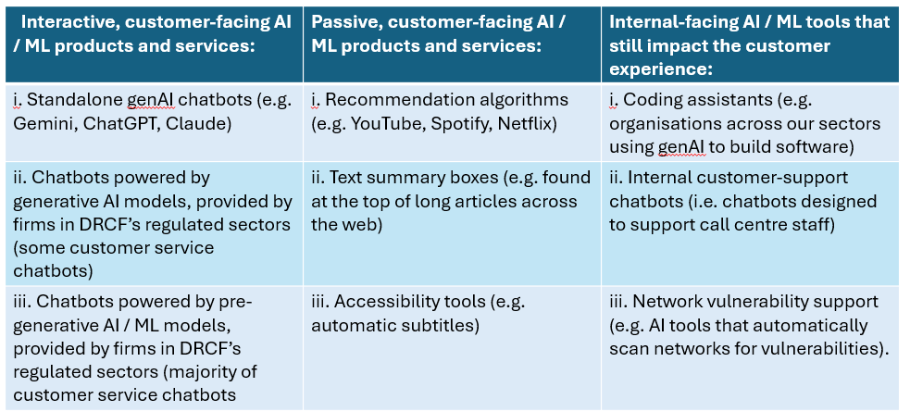
We recognise that AI tools take many forms, extending beyond ‘generative’2 and 'agentic'3 categories. Considerations should primarily focus on consumer‑facing services, but respondents may also include information on ‘back‑office’ AI-driven decisions that materially affect consumers. Below is a non-exhaustive list of examples that respondents may wish to refer to. We would encourage respondents to be as precise as possible in their submissions, when referring to ‘AI’.
As our aim is to gather information, we are not planning to provide advice or guidance in response to questions that may be raised in this call for views.
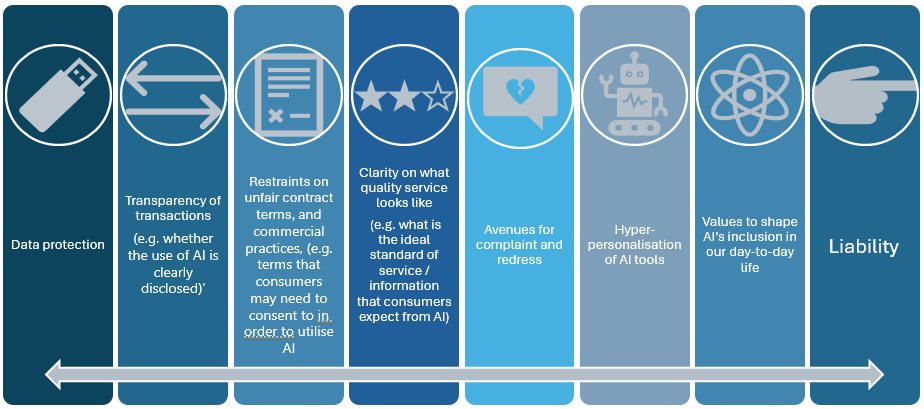
We propose to focus our work on the themes listed below. We have selected these themes as they featured prominently as part of our past AI work within the Thematic Hub and HSET workstreams:
Call for Input Questions
Consumer Attitudes (Q1-Q16)
Deadline 3rd July 2026
Consumer risk tolerance and expectations:
1. To what extent should we expect consumers to understand the full risks associated with AI and manage those risks?
2. Is there a particular category of consumers who may be at higher risks of harm (e.g. specific categories of vulnerable consumers)?
3. Are there particular values that consumers feel more strongly should be upheld when interacting with AI? E.g. non-discrimination, fairness, privacy, accessibility and others.
4. To what extent do you see consumers being willing to tolerate risks from generative or agentic AI in the face of perceived benefits, and how do they articulate this trade-off? Perceived benefits may include better market outcome and lower costs, saving significant time and increased convenience, despite the risks listed below. E.g.:
- the possibility of AI agents causing unauthorised or erroneous transactions
- agentic collusion with the possibility of price spikes.
- AI hallucinations
- Risks, if any, related to hyper-personalisation of AI (manipulation, breaches of privacy, data security) etc.
- Response quality
- Broader societal impact
- AI gaining capabilities or influence that outpace our ability to control, govern, or properly oversee them.
Transparency4, literacy and consent:
5. How much human intervention or oversight do consumers expect when using AI (if any)?
6. What do you believe is the current level of AI consumer literacy?
- Should consumers actively seek to improve their AI understanding, or should the responsibility be on providers/platforms to ensure clear understanding and safe use?
7. Is there a perception of data protection risks across consumers, and is that outweighed by perceived benefits?
8. Would standardised disclosures about AI data use and behaviour (e.g. “does not retain data”) improve trust? Which disclosures matter most?
9. To what extent do consumers meaningfully engage with AI-related disclosures, and what formats (e.g. reading terms and conditions, summaries, labels, prompts) improve engagement?
10. To what extent do consumers perceive the benefits (e.g. more tailored advice / service) versus the risks (e.g. data breaches, discrimination, fraud etc.) of AI becoming increasingly personalised? Is a higher level of personalisation a desirable outcome?
11. What would give consumers confidence that it is appropriate to trust an AI system? E.g. government-backed trust marks or access via trusted public platforms, verifiable accreditations (registration numbers, public registries, certification schemes).
- To what extent could simple, user facing controls over agent behaviour (e.g. “approve before action”; “never make purchases without confirmation”) help to build trust?
12. Do consumers’ perceptions of risk and trust vary depending on the type of AI they are using - for example, whether the AI is embedded within a specific firm’s service (such as a built-in chatbot) or provided by an external system, such as ChatGPT?
Quality & accountability5:
13. What defines high-quality AI service (e.g. accuracy, reliability, fairness, transparency, user control), and how should it be measured?
14. How do existing terms and conditions include or reflect risks of AI?
15. What redress mechanisms exist today, how accessible are they, and do consumers trust them to resolve AI-related harms?
- Does the availability of clear complaint routes and escalation to an ombudsman or regulator increase consumer confidence?
- Should regulators mandate strict liability in order to facilitate redress measures?
16. Who do consumers expect to be accountable when AI causes harm (provider, developer, user)? Does this differ for generative vs agentic AI?
Regulatory, policymakers, industry & consumers tools (Q17 – Q28)
Deadline 2nd September
In the second phase of this research, we plan to explore what tools are or should be available to consumers, industry, regulators and policy-makers to counteract the risks of AI. While Phase (1) focuses on consumer attitudes and risk tolerance, Phase (2) asks a different question: what are the tools for consumer protection to be delivered effectively in practice, given the complexity, opacity and speed of AI6.
Placing the onus exclusively on individual consumers for managing AI risks may not be efficient in digital and AI driven markets. Reliance on recurrent consent requests, terms and conditions, and individual choice often assumes levels of interest or understanding that consumers may not realistically have.
We are particularly interested in what regulatory tools, and compliance frameworks / obligations on firms and other actors can deliver good consumer outcomes, and monitor and mitigate risks7. We welcome views from small and medium sized enterprises (SMEs) as well as larger organisations, to understand whether these tools and frameworks could be beneficial to firms of different sizes.
In this second phase we welcome responses primarily of academic or conceptual nature and encourage submissions grounded in empirical evidence, interdisciplinary research, and practical policy proposals.
Tools:
17. What tools can industry offer to consumers or otherwise implement (risk governance frameworks, impact assessments or others) to manage AI risks8?
18. Should consumers be able to opt-out of AI, and if not, what is the legal basis for the use of their data?
19. What tools, frameworks or standards can regulators leverage to safeguard consumer protection? Can these be easily adapted or transferred on a cross-sectoral basis?
20. What types / modes of guidance or other regulatory tools are most helpful to industry for achieving compliance – e.g. detailed guidance, sandboxes and others. If any effective international examples come to mind please refer to these.
21. What is the current application of AI standards, if any, and is there international best practice?
22. Is informed and meaningful ‘consent’ the right lever to ensure a consumer is protected and aware of risks?
23. Are there any other levers (e.g. cooling-off periods, right to opt-out of using AI, ‘cookies’-like requests)?
24. Are there existing examples in other sectors or jurisdictions who utilise tools efficiently?
25. Can outcomes-based approaches, analogous to 'Consumer Duty' type frameworks, where firms are expected to actively consider and deliver fair outcomes, be a vehicle for consumer protection?
Accountability:
26. Who should be held accountable, and to what extent, for AI risks materialising? Consumer, firms (including integrators, developers), or regulators?
Risk:
27. Do ‘tolerable risks’ exist for consumers in these contexts, and if so, how should policymakers/regulators define and operationalise? What about industry?
28. What metrics, thresholds or proxy indicators are feasible?
Who Should Respond
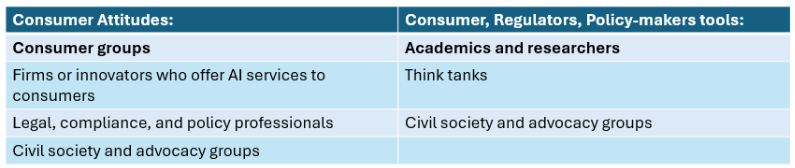
We welcome input from:
How to Respond
Please submit your views via drcf@ofcom.org.uk, referring to the deadlines specified above. You may respond to any or all the questions above or share other insights you believe are relevant.
Responses will be analysed by the DRCF project team and may inform future thematic work, including webinars, roundtables, and 2027 DRCF Responsible AI Forum.
The DRCF is not a standalone legal entity, and, for the avoidance of doubt, information submitted in response to this call for views should be treated as information submitted to each DRCF member regulator (CMA, Ofcom, ICO and FCA). To note, any information members of the DRCF receive as part of this consultation may be subject to a freedom of information request under the Freedom of Information Act 2000. For more information about how we handle personal data please see the DRCF Privacy Policy.
Footnotes
1 Non-exhaustive regulatory AI work includes the upcoming FCA Mills review, Ofcom’s upcoming research to inform its work on ‘Understanding how people and businesses can benefit from AI in telecoms markets’, CMA’s recent publication around ‘Agentic AI and consumers’ and ‘AI and collusion’, and ICO’s Tech Futures: Agentic AI.
2 Generative AI (also referred as gen AI) is AI able to create original content such as text, images, video, audio or software code in response to a user’s prompt or request.
3 Agentic AI broadly refers to AI systems capable of autonomous decision-making and initiating actions without direct human prompts.
4 By transparency, we refer to the extent to which consumers are able to access, understand, and meaningfully engage with information about how an AI system operates. This includes its behaviour, use of data, risks (such as bias), and available user controls.
5 For the purposes of this CFI, we refer to accountability as the extent to which appropriate audit trails and governance mechanisms are in place to enable errors or harmful outcomes generated by AI to be identified, investigated, remediated, and attributed to the responsible party.
6 Considerations should primarily focus on consumer‑facing services, but respondents may also include information on ‘back‑office’ AI-driven decisions that materially affect consumers where relevant.
7 An example could be the development of outcomes‑based approaches, analogous to 'Consumer Duty' type frameworks, where firms are expected to actively consider and deliver fair outcomes, rather than comply with prescriptive requirements.
8 As part of this question, we are interested in whether consumers’ understanding of a future framework is relevant / recommended. For example, it would be useful to explore whether consumers benefit from knowing that specific provisions or frameworks are in place to support fair outcomes.